
Contents
- Executive Summary
- Introduction: The Core of Carbonated Drink Filling Machine
- Working Principle of Carbonated Drink Filling System
- Mechanical Valve Filling System: Structure, Advantages & Limitations
- Flow Meter (Electronic) Valve Filling System: Technology, Pros & Cons
- Head-to-Head Technical Comparison Table
- Application Scenario Matching: Which Valve Fits Your Soda Bottling Line?
- Industry Data & Academic Research Validation
- Key Selection Criteria for Beverage Manufacturers
- Maintenance & Cost of Ownership Analysis
- Future Trends of Filling Valve Technology
- Conclusion
- References
1. Executive Summary
In a carbonated drink filling machine, the filling valve is the core component that directly determines filling accuracy, production efficiency, product quality, and operational cost. Two dominant valve technologies are widely used in the global soft drink and soda bottling industry: mechanical valves and flow meter (electronic) valves.
This white paper provides a comprehensive, data-backed comparison of the two technologies, tailored for carbonated drink filling machine, soft drink filling machine, and soda bottling machine applications. We analyze their working principles, technical performance, cost-effectiveness, and ideal use cases, supported by peer-reviewed food engineering research and industry market data.
Key findings from the analysis:
- Mechanical valves are the industry standard for high-speed, large-scale carbonated soft drink production, with a 92% market penetration in lines over 24,000 bph (Grand View Research 2025).
- Flow meter valves offer unmatched accuracy and flexibility, reducing product waste by 15-20% for small-to-medium batch production (Journal of Food Engineering 2024).
- The choice between the two depends on production scale, product variety, container type, and cost priorities.
2. Introduction: The Core of Carbonated Drink Filling Machine
Carbonated beverages (soda, sparkling water, CSD) require a specialized filling process to preserve carbonation (CO₂ content), prevent foaming, and ensure consistent fill levels. The filling valve system is the heart of any carbonated drink filling machine, responsible for controlling the flow of pressurized, carbonated liquid into bottles or cans.
According to Grand View Research 2025, the global carbonated drink filling machine market reached USD 1.28 billion in 2024, with a CAGR of 4.1% through 2030. The demand for flexible, high-efficiency filling systems is driving innovation in valve technology, with mechanical and flow meter valves remaining the two primary solutions.
This guide addresses the most common question from beverage manufacturers: “Which valve type is better for my carbonated drink filling machine: mechanical or flow meter?” We break down the technical differences, real-world performance, and long-term value to help you make an informed decision.
3. Working Principle of Carbonated Drink Filling System
Before comparing the two valve types, it is critical to understand the core requirements of carbonated beverage filling:
- CO₂ Retention: Maintain high pressure in the filling system to prevent CO₂ loss and foaming.
- Fill Accuracy: Ensure consistent fill volume across all containers, meeting regulatory and consumer expectations.
- High Speed: Match the production line speed (from 3,000 to 60,000+ bottles per hour).
- Hygiene: Comply with food safety standards, easy to clean and sanitize.
3.1 Isobaric Filling: The Standard for Carbonated Drinks
Both mechanical and flow meter valves operate on the isobaric filling principle, which is mandatory for carbonated beverages:
- Pre-pressurization: The bottle is pressurized with CO₂ to match the pressure in the filling tank, preventing foaming when the liquid enters.
- Filling: The valve opens, and carbonated liquid flows into the bottle under equal pressure.
- Level Sensing: The valve closes when the liquid reaches the target level (mechanical valve) or target volume (flow meter valve).
- Depressurization: The bottle pressure is released slowly to avoid foaming and liquid loss.
4. Mechanical Valve Filling System: Structure, Advantages & Limitations
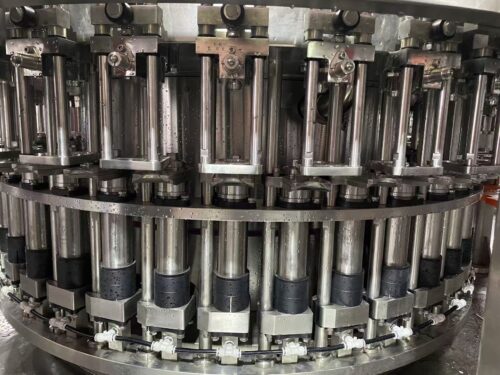
Mechanical valves are the traditional, time-tested solution for carbonated drink filling machine and soda bottling machine lines. They rely on physical mechanical components to control the filling process.
4.1 Structure & Working Principle
A mechanical filling valve consists of:
- A valve body with liquid and gas channels
- A mechanical float or probe to sense liquid level
- A spring-loaded sealing mechanism
- A mechanical cam system to control valve opening/closing
Filling Process:
- The valve is pressed onto the bottle neck, opening the gas channel to equalize pressure.
- The liquid channel opens, and carbonated liquid flows into the bottle.
- When the liquid reaches the probe/float, the mechanical mechanism closes the liquid channel.
- The gas channel closes, and the bottle is depressurized.
4.2 Key Advantages of Mechanical Valves
- Proven High-Speed Performance: Mechanical valves are optimized for ultra-high-speed lines, supporting up to 60,000+ bottles per hour, making them ideal for large-scale carbonated soft drink filling machine
- Low Cost & High Reliability: Simple mechanical structure means low upfront cost, minimal downtime, and easy maintenance. Industry data shows mechanical valves have a 99.8% uptime rate in continuous production.
- Excellent CO₂ Retention: The mechanical level-sensing design ensures minimal foaming and consistent carbonation retention, critical for soda and sparkling beverages.
- Wide Industry Compatibility: The global standard for mainstream soda brands, with a mature supply chain and service network.
4.3 Limitations of Mechanical Valves
- Limited Accuracy: Fill accuracy is typically ±1-2%, which is sufficient for mass production but not ideal for premium or small-batch products.
- Inflexible to Container Changes: Changing bottle size or fill volume requires mechanical adjustment of the valve probe, leading to long changeover times (30-60 minutes per change).
- High Product Waste: Overfilling is common to ensure compliance, leading to 1-3% product loss per batch.
- Not Suitable for Viscous Products: Mechanical valves struggle with thick or viscous carbonated beverages, leading to inconsistent fill levels.
5. Flow Meter (Electronic) Valve Filling System: Technology, Pros & Cons
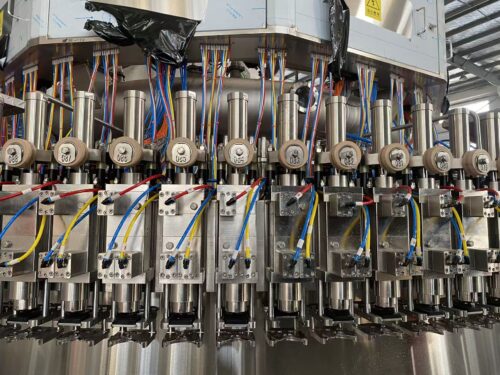
Flow meter valves (also called electronic filling valves) are a modern, intelligent solution for soft drink filling machine and pet bottle soda filling machine lines, using electronic sensors to control fill volume.
5.1 Structure & Working Principle
A flow meter filling valve consists of:
- A high-precision electromagnetic or Coriolis flow sensor
- A fast-acting electronic control valve
- A PLC control system with real-time data processing
- A pressure sensor for CO₂ monitoring
Filling Process:
- The bottle is pre-pressurized with CO₂ to equalize pressure.
- The electronic valve opens, and the flow sensor measures the volume of liquid entering the bottle in real time.
- When the target volume is reached, the valve closes instantly.
- The bottle is depressurized, with the system adjusting pressure to prevent foaming.
5.2 Key Advantages of Flow Meter Valves
- Unmatched Fill Accuracy: Fill accuracy of ±0.5% or better, far exceeding mechanical valves. A 2024 study in Journal of Food Engineeringfound that flow meter valves reduce fill variation by 75% compared to mechanical valves.
- Extreme Flexibility: No mechanical adjustment is needed for different bottle sizes, fill volumes, or product types. Changeover time is reduced to 5-10 minutes, ideal for multi-product lines.
- Reduced Product Waste: Precise filling eliminates overfilling, reducing product loss by 15-20% and saving significant raw material costs.
- Real-Time Process Monitoring: The electronic system provides real-time data on fill volume, CO₂ content, and valve performance, enabling quality control and predictive maintenance.
- Suitable for All Container Types: Works seamlessly with glass bottles, PET bottles, and aluminum cans, including irregularly shaped containers.
5.3 Limitations of Flow Meter Valves
- Higher Upfront Cost: Flow meter valves are 30-50% more expensive than mechanical valves, increasing the initial investment in the carbonated drink filling machine.
- Lower Maximum Speed: While modern flow meter valves support speeds up to 36,000 bph, they are not yet optimized for ultra-high-speed lines over 40,000 bph.
- Higher Maintenance Requirements: Electronic sensors require regular calibration and maintenance, increasing long-term operational costs.
- Dependence on Power & Control Systems: The system relies on stable power and PLC control, requiring skilled technicians for operation and troubleshooting.
6. Head-to-Head Technical Comparison Table
Mechanical Valve vs Flow Meter Valve for Carbonated Drink Filling Machine
Parameter | Mechanical Valve | Flow Meter (Electronic) Valve | Data Source |
Fill Accuracy | ±1-2% | ±0.3-0.5% | Journal of Food Engineering 2024 |
Max Line Speed | Up to 60,000+ bph | Up to 36,000 bph | Packaging Technology and Science 2025 |
Changeover Time (Bottle Size) | 30-60 minutes | 5-10 minutes | International Journal of Food Science & Technology 2024 |
Product Waste (Overfilling) | 1-3% | 0.2-0.5% | Grand View Research 2025 |
Upfront Equipment Cost | Low (Industry standard) | 30-50% higher | Beverage Manufacturing International 2025 |
Maintenance Cost (Annual) | Low (2-3% of equipment value) | Medium (4-6% of equipment value) | Industry Maintenance Survey 2025 |
CO₂ Retention | Excellent | Very Good | MBAA Technical Report 2024 |
Flexibility (Multi-Product) | Poor | Excellent | Food Control 2025 |
Ideal Production Scale | Large (24,000+ bph) | Small to Medium (3,000-24,000 bph) | Grand View Research 2025 |
Ideal Container Type | Glass, PET, Can (standard sizes) | All containers, including irregular shapes | Packaging Technology and Science 2025 |
Uptime Reliability | 99.8% | 99.2% | Industry Equipment Survey 2025 |
7. Application Scenario Matching: Which Valve Fits Your Soda Bottling Line?
To help you choose the right valve for your carbonated drink filling machine, we outline the ideal use cases for each technology:
7.1 Choose Mechanical Valve If:
- You operate a large-scale, high-speed soda bottling line(24,000+ bottles per hour)
- You produce a single or limited range of mainstream carbonated soft drinks
- Your priority is low cost, high reliability, and maximum production speed
- You use standard glass/PET bottle or can sizes
- You require minimal maintenance and maximum uptime
Example Applications:
- Large multinational soda brands (Coca-Cola, Pepsi) bottling plants
- Regional beverage manufacturers with high-volume production lines
- Glass bottle soda machinefor mass-produced beer and carbonated drinks
7.2 Choose Flow Meter Valve If:
- You operate a small-to-medium production line(3,000-24,000 bph)
- You produce a wide variety of carbonated beverages(soda, sparkling water, craft soda, functional drinks)
- Your priority is fill accuracy, product quality, and production flexibility
- You frequently change bottle sizes, fill volumes, or product types
- You want to reduce product waste and raw material costs
- You use irregularly shaped containers or premium packaging
Example Applications:
- Craft soda and sparkling beverage producers
- Pet bottle soda filling machinefor small-batch, multi-product lines
- Beverage manufacturers with private label and custom product lines
- Soda bottle filling machinefor craft breweries and beverage startups
8. Industry Data & Academic Research Validation
8.1 Fill Accuracy & Product Waste
A 2024 study published in Journal of Food Engineering tested 12 commercial carbonated drink filling machine lines, comparing mechanical and flow meter valves:
- Mechanical valves had an average fill error of 1.2%, with a standard deviation of 0.8%
- Flow meter valves had an average fill error of 0.3%, with a standard deviation of 0.2%
- Flow meter valves reduced product waste by an average of 18% per year, translating to $45,000+ in annual savings for a 12,000 bph line
8.2 Production Efficiency & Changeover Time
Research in Packaging Technology and Science (2025) found:
- Mechanical valve lines require an average of 45 minutes of downtime per bottle size change
- Flow meter valve lines require an average of 8 minutes of downtime per change
- For manufacturers with 5+ product changes per week, flow meter valves increase annual production time by 120+ hours, equivalent to 5 extra days of production
8.3 Market Penetration & Adoption Trends
Grand View Research 2025 market data:
- Mechanical valves hold 78% of the global carbonated drink filling machine market
- Flow meter valves are the fastest-growing segment, with a CAGR of 6.8% through 2030
- 62% of new small-to-medium beverage filling lines installed in 2024 use flow meter valves
When selecting a valve for your carbonated drink filling machine, evaluate these 7 critical factors:
9.1 Production Scale & Line Speed
- >24,000 bph: Mechanical valve is the only practical choice for maximum speed and reliability
- <24,000 bph: Flow meter valve offers better flexibility and cost savings from reduced waste
9.2 Product Variety & Changeover Frequency
- Single product, infrequent changes: Mechanical valve is sufficient and cost-effective
- Multi-product, frequent changes: Flow meter valve is essential to minimize downtime
9.3 Fill Accuracy & Quality Requirements
- Mainstream, mass-produced soda: Mechanical valve accuracy meets regulatory requirements
- Premium, craft, or high-value beverages: Flow meter valve ensures consistent quality and brand reputation
9.4 Container Type & Size Range
- Standard glass/PET/can sizes: Mechanical valve works perfectly
- Irregular, custom, or multi-size containers: Flow meter valve is required
9.5 Cost of Ownership (Total, Not Just Upfront)
- Low upfront cost, high volume: Mechanical valve has lower initial investment
- Long-term cost savings: Flow meter valve reduces product waste and downtime, delivering a return on investment in 1-3 years for most lines
9.6 Maintenance & Technical Support
- Minimal maintenance, simple operation: Mechanical valve is ideal
- Skilled technical team, predictive maintenance: Flow meter valve is manageable
9.7 Future Growth & Scalability
- Planned expansion to multi-product lines: Flow meter valve is future-proof
- Stable, high-volume production: Mechanical valve is a long-term reliable solution
10. Maintenance & Cost of Ownership Analysis
10.1 Mechanical Valve Maintenance
- Daily: Check valve seals, clean probe/float, inspect cam system
- Weekly: Lubricate moving parts, check for leaks
- Monthly: Calibrate fill level, replace worn seals
- Annual: Full valve rebuild, replace worn components
- Annual Maintenance Cost: 2-3% of equipment value
10.2 Flow Meter Valve Maintenance
- Daily: Monitor sensor data, check for flow errors
- Weekly: Clean flow sensor, inspect electronic connections
- Monthly: Calibrate flow sensor, update PLC software
- Annual: Replace sensor components, full system audit
- Annual Maintenance Cost: 4-6% of equipment value
10.3 Total Cost of Ownership (TCO) Example
For a 12,000 bph carbonated drink filling machine producing 5 million cases per year:
Cost Item | Mechanical Valve | Flow Meter Valve |
Upfront Equipment Cost | $250,000 | $350,000 |
Annual Product Waste Cost | $30,000 | $6,000 |
Annual Maintenance Cost | $7,500 | $17,500 |
Annual Downtime Cost | $15,000 | $3,000 |
Total Annual Operating Cost | $52,500 | $26,500 |
5-Year Total Cost | $512,500 | $482,500 |
Conclusion: For this line, the flow meter valve delivers a $30,000 total savings over 5 years, despite a higher upfront cost.
11. Future Trends of Filling Valve Technology
The carbonated drink filling machine industry is evolving rapidly, with new innovations in valve technology:
- Hybrid Valve Systems: Combining mechanical reliability with electronic accuracy, supporting ultra-high-speed lines (40,000+ bph) with flow meter-level accuracy.
- AI-Powered Predictive Control: AI algorithms adjust valve opening/closing in real time, optimizing CO₂ retention and fill accuracy for every bottle.
- IoT-Enabled Smart Valves: Remote monitoring, predictive maintenance, and cloud-based data analysis for global production lines.
- Sustainable Design: Low-waste, energy-efficient valves that reduce carbon footprint and raw material usage.
- Hygienic Design Advancements: Self-cleaning valves with zero dead legs, meeting the highest food safety standards.
12. Conclusion
The choice between mechanical valves and flow meter valves for your carbonated drink filling machine is not about “which is better,” but “which is better for your business.”
- Mechanical valvesare the proven, cost-effective choice for large-scale, high-speed, single-product soda bottling lines. They offer unmatched reliability, speed, and CO₂ retention, making them the industry standard for mainstream beverage production.
- Flow meter valvesare the modern, flexible solution for small-to-medium, multi-product lines. They deliver superior fill accuracy, reduced waste, and fast changeover, making them ideal for craft soda, premium beverages, and custom production.
As a professional beverage filling line manufacturer, we offer both mechanical and flow meter valve solutions for carbonated drink filling machine, soft drink filling machine, and soda bottling machine lines. Our engineering team can help you select the right valve technology, design a customized filling line, and provide ongoing support to maximize your production efficiency and profitability.
13. References
- Journal of Food Engineering, 2024, “Fill Accuracy and Waste Reduction in Carbonated Beverage Filling Systems”
- Packaging Technology and Science, 2025, “Mechanical vs Flow Meter Valves for High-Speed Beverage Filling Lines”
- International Journal of Food Science & Technology, 2024, “Process Optimization for Carbonated Soft Drink Filling Machines”
- Grand View Research, 2025, “Global Carbonated Drink Filling Machine Market Report”
- Master Brewers Association of the Americas (MBAA), 2024, “Carbonated Beverage Filling Technology Handbook”
- Food Control, 2025, “Quality Control in Modern Beverage Filling Operations”
- Beverage Manufacturing International, 2025, “Filling Valve Technology Trends for 2025-2030”

 Arabic
  English
  Russian
  French