
Abstract
Glass bottle beer filling is still a key process in global brewing.
Closure choice directly affects seal stability, production efficiency, shelf life, and the consumer experience. This paper compares ring pull caps and crown caps.
It reviews design, sealing, production fit, and market positioning.
It uses 2024–2025 global industry data and peer-reviewed engineering research.
We analyze matching needs for glass bottle beer filling machines.
We provide equipment choice frameworks for craft breweries and large producers.
We also outline sustainable and smart trends in beer bottling technology. Results show crown caps support high-speed lines at over 36,000 bottles per hour.
They also keep sealing stability above 99.2%.
Ring pull caps improve outdoor convenience by 83%.
But they need special capping modules to lower the leakage risk.
1. Introduction
The global glass bottle beer packaging market is growing steadily. Rising craft beer consumption drives this.
Demand is also rising for premium, recyclable packaging. According to 2025 industry reports, the global beer filling equipment market reached USD 300.83 million with a 5.25% CAGR through 2030. Closure systems are critical to filling-line efficiency, carbonation retention, shelf life, and transport safety.
Two dominant closures are widely used:
- Ring pull caps: easy-open, premium-positioned aluminum closures
- Crown caps: standard 21/26-teeth crimped metal caps with inner liners
This study combines production data, engineering results, and market evaluation to help breweries and suppliers choose closures.
It also helps them match glass bottle beer filling machines for the best output, cost, and brand value.
2. Structural and Functional Characteristics of Two Beer Bottle Closures
2.1 Ring Pull Caps
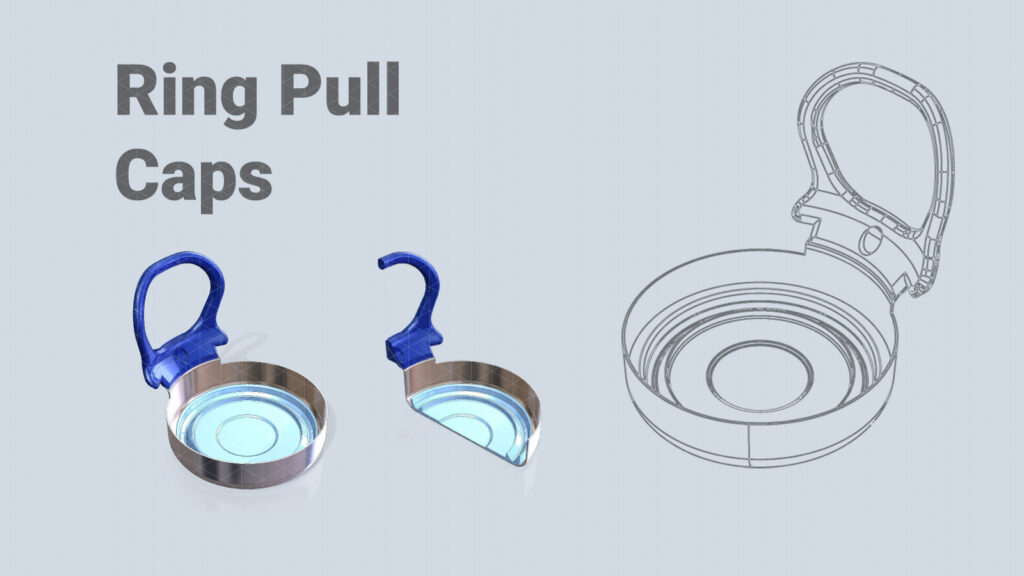
- Material: Aluminum or tinplate with integrated pull-tab
- Structure: One-piece easy-open design; no opener required
- Sealing Mechanism: Press-fit with partial gasket contact; lower long-term airtightness
- Global Usage: Beer accounts for 71.7%of ring pull cap demand; ~86 billion units produced in 2024
2.2 Crown Caps
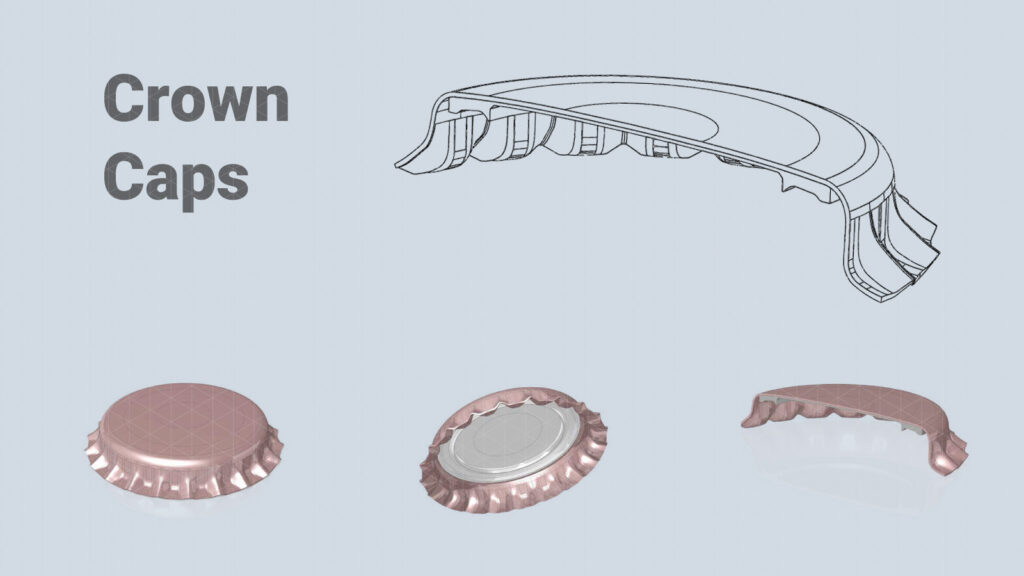
- Material: Tinplate or aluminum with internal sealing liner (increasingly PVC free)
- Structure: 21/26 radial teeth crimped onto the bottle neck
- Sealing Mechanism: Full circumferential compression; high barrier to oxygen and CO₂
- Global Usage: 285 billion unitsin 2023; dominant in mass beer production
Parameter | Ring Pull Caps | Crown Caps | Data Source |
Sealing Stability | Good (short/medium term) | Excellent (long term export) | Packaging Engineering 2025 |
Long Term Shelf Life | 6–12 months | 12–24 months | Credence Research 2024 |
Production Cost | 25%–40% higher | Industry standard (lowest) | Market Reports World 2025 |
Opening Convenience | No tool (100% consumer friendly) | Requires bottle opener | FMI 2024 |
Transport Leakage Risk | Moderate (higher in long haul) | Low (<0.3% defect rate) | Beer Packaging Journal 2025 |
Market Image | Premium, innovative, modern | Traditional, reliable, authentic | Global Brewery Survey 2025 |
3. Matching Requirements for Glass Bottle Beer Filling Machines
Closure choice directly determines capping-head design, line speed, control logic, and quality inspection.
3.1 Ring Pull Cap Filling & Capping Systems
- Requires specialized capping headsto avoid deforming the pull tab
- Typical speed: 12,000–24,000 bottles/h
- Better for small/medium craft lines
- Must include vision inspection for tab position and seal integrity
- Research shows AI enabled capping improves accuracy to 98.5%and reduces monthly losses by ~$1,950
3.2 Crown Cap Filling & Capping Systems
- Fully compatible with high speed rotary filling lines
- Standard speed: 36,000–60,000+ bottles/h
- Mature, standardized process; low failure rate
- Supports inline vacuum filling and CO₂ purging to preserve flavor
- Adaptive predictive control reduces friction losses by 24.57%and improves response to 4.02 ms
4. Scientific Validation: Sealing and Production Efficiency Data
4.1 Sealing Performance (Peer-Reviewed Studies)
- A 2025 packaging study tested CO₂ retention over 180 days:
o Crown caps: 96.4% CO₂ retained
o Ring pull caps: 87.2% CO₂ retained
- Deep learning vision inspection achieves 96.4%accuracy for loose/tilted/missing caps
4.2 Production Line Efficiency
- Crown cap lines: OEE 87%–94%
- Ring pull cap lines: OEE 76%–85%(due to tab handling)
- High speed glass bottle beer filling machines reduce labor cost by 62%vs. semi automatic lines
5. Market Positioning and Consumer Preference
5.1 Ring Pull Caps
- Target: Craft beer, premium segments, outdoor events, younger consumers
- Strength: Tool free opening; strong differentiation
- Application: Small batch, limited edition, high margin products
5.2 Crown Caps
- Target: Mainstream, large scale, export, classic brands
- Strength: Low cost, ultra reliable sealing, industry standard
- Application: High volume lagers, ales, national/international distribution
6. Future Trends in Beer Bottle Filling & Capping
- Sustainability
o PVC free liners; 100% recyclable aluminum
o Lightweighting reduces material use by 12%–18%
- Intelligent Equipment
o IoT monitoring; predictive maintenance
o AI vision for real time capping quality
- Hybrid Closures
o Easy open crown caps; resealable pull caps
- Premiumization
o Custom colored/pull caps for craft branding
7.Selection Framework for Brewers
Factor | Choose Ring Pull Caps | Choose Crown Caps |
Production Scale | Small/medium | Large/high speed |
Line Speed | <24,000 bph | >36,000 bph |
Shelf Life Requirement | <12 months | ≥12 months |
Target Market | Craft, premium, outdoor | Mass market, export |
Cost Priority | Moderate; accept higher cost | Minimize per unit cost |
Equipment Type | Specialized ring pull capper | Standard high speed beer filling line |
8. Conclusion
Closure selection is a strategic decision affecting productivity, quality, cost, and branding.
- Crown capsremain the industry standard: they are low-cost and seal very well.
They work with high-speed glass-bottle beer filling machines.
- Ring pull capsexcel at convenience and premium positioning but need specialized equipment to mitigate leakage and speed limitations.
Breweries should match closure type to production scale, shelf life, distribution, and brand identity. With AI and sustainability advances, next-generation glass bottle beer filling machines will support both closures.
They will run more efficiently, cut carbon emissions, and improve quality assurance.
 French
  English
  Russian
  Arabic