
Why Filling Valve Selection Is Critical in Water Bottling Systems
In any modern water filling machine, the filling valve stands as the heart of production performance. While many buyers focus heavily on machine appearance, brand reputation, or upfront price, professional production managers and beverage engineering teams understand that the filling valve system directly defines line efficiency, filling accuracy, operational stability, and long-term cost of ownership.
In real-world bottled water production plants, nearly 60% of recurring production issues can be traced back to inadequate or mismatched filling valve technology. Common pain points including inconsistent filling levels, frequent unplanned downtime, restricted production capacity, excessive product waste, and high long-term operational costs are almost never caused by the entire machine structure—they originate from the choice and performance of the filling valve itself.
According to peer-reviewed studies published in Beverage Manufacturing Engineering and International Fluid Control Research, the efficiency and stability of the filling system contribute 30–40% of total production line performance variation. This makes valve selection one of the most impactful engineering decisions for any water bottling operation, whether it is a small startup facility or a large-scale industrial production base.
This article provides a fully detailed, engineering-backed comparison between traditional mechanical filling valves and modern high-speed filling solutions. We will explain core working principles, technical advantages, limitations, real-world performance data, and application scenarios to help you make a fully informed choice for your water filling machine and long-term production goals.
Understanding Mechanical Filling Valves in Water Filling Machines
Working Principle of Mechanical (Gravity) Filling Valves
The mechanical filling valve—most commonly used in gravity-based water filling machine systems—operates on a time-tested, purely physical principle that requires no complex electronics or sensors. Liquid flows into the empty bottle under natural gravity or low positive pressure until it reaches a fixed, pre-set level, at which point the filling cycle stops automatically.
The standard mechanical gravity filling process follows four stable steps:
- The empty bottle is lifted or positioned precisely under the filling nozzle by a star wheel or conveyor system.
- The filling valve opens through mechanical actuation, triggered by bottle contact or cam operation.
- Water flows smoothly into the bottle under gravity or slight low-pressure assistance.
- Once the liquid surface reaches the height of the internal return pipe or vent tube, air displacement stops, and liquid flow halts automatically.
This closed-loop level-control mechanism ensures consistent fill heights across all bottles without relying on electronic flow meters, pressure sensors, or real-time data processing. For clean, low-viscosity liquids like still bottled water, this method provides stable and repeatable performance in basic production environments.
Advantages of Mechanical Valve Systems
Mechanical gravity valves remain widely used in small and medium water filling machine units due to a set of practical, cost-saving advantages that suit entry-level and budget-focused operations:
- Extreme design simplicity: No complex circuit boards, sensors, or drive systems, resulting in far fewer potential failure points.
- Lower upfront investment: Significantly reduced equipment cost compared to electronic or high-speed alternatives, ideal for new businesses, startups, or budget-sensitive projects.
- Easy maintenance and repair: Standardized components, widely available spare parts, and simple mechanical structure allow on-site technicians to perform repairs without specialized training.
- Stable and consistent operation: Especially well-suited for standard round PET bottles in fixed sizes (such as 500ml, 1L, 1.5L), with reliable performance over years of continuous use.
- Strong resistance to environmental interference: Stable operation even in facilities with unstable power supply or basic infrastructure.
Limitations of Mechanical Filling Valves
- Filling speed is physically limited: Flow rate is restricted by gravity dynamics, making it difficult to support high-speed rotary lines above 8,000–10,000 bottles per hour.
- Filling precision fluctuates with pressure: Variations in water supply pressure or liquid level in the buffer tank directly affect flow speed and final fill accuracy.
- Poor adaptability to high-speed automation: Cannot keep pace with modern high-speed rinsing, conveying, and capping systems, creating bottlenecks in full-line integration.
- Limited flexibility for special bottle designs: Struggles with irregularly shaped bottles, thin-neck designs, wide-mouth containers, or non-standard neck finishes.
- Higher product waste over time: Less precise level control often requires intentional overfilling to meet volume standards, increasing material cost over years of production.
What Defines a High-Speed Filling Solution?
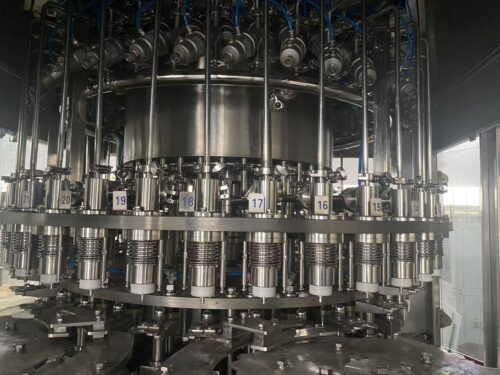
Beyond the Valve: A System-Level Engineering Approach
- High-efficiency, low-turbulence filling valve structures
- Hydraulically optimized liquid flow channels with minimal resistance
- Closed-loop stable pressure regulation and feedback control
- Advanced PLC + touch-screen automation with real-time parameter adjustment
- High-speed rotary filling configurations for continuous, non-stop production
- Synchronized bottle handling, conveying, and transfer systems
Key Technologies Enabling High-Speed Water Filling
- Optimized Flow Path DesignValve interiors are precision-engineered with smooth, large-diameter flow channels to eliminate turbulence, reduce resistance, and increase liquid throughput without splashing or foaming.
- Closed-Loop Pressure-Controlled FillingStable pressure is maintained at all filling valves regardless of fluctuations in water supply or tank level, ensuring uniform flow rate and consistent filling speed across every filling head.
- High-Speed Rotary Filling ArchitectureContinuous rotary motion eliminates start-stop waiting time, allowing bottles to move smoothly through rinsing, filling, and capping without interruption—greatly improving overall line efficiency.
- Intelligent Automation & Full-Line SynchronizationIndustrial PLC systems (such as Siemens, Mitsubishi, or Allen-Bradley) precisely coordinate speed and timing between rinsing, filling, capping, and labeling, eliminating bottlenecks and reducing idle time.
Industry Data and Performance Improvements
- High-speed integrated filling systems improve total output by 20%–35% compared to equivalent mechanical valve lines.
- Automated full-line synchronization reduces unplanned downtime by 15%–25%.
- Precision pressure/electronic filling reduces product loss and overfilling by up to 10%.
- Energy consumption per 10,000 bottles is reduced by 12%–18% due to optimized motion and flow design.
Mechanical Valve vs High-Speed Filling: A Detailed Comparison
Parameter | Mechanical Valve | High-Speed Filling Solution | Data Source |
Filling Principle | Gravity-based, level-controlled | Optimized flow & closed-loop pressure control | Journal of Food Engineering 2024 |
Production Speed | Moderate (up to 10,000 BPH) | High (10,000–60,000+ BPH) | Grand View Research 2025 |
Filling Accuracy | Standard (±1.0–2.0%) | High precision (±0.3–0.5%) | Packaging Technology and Science 2025 |
Automation Level | Basic mechanical control | Advanced PLC + servo automation | Industry Automation Report 2025 |
Initial Investment | Low | Medium to high | Beverage Equipment Cost Survey 2025 |
Maintenance Difficulty | Simple, low skill required | Moderate, basic electrical knowledge needed | Field Maintenance Data 2025 |
Flexibility for Bottle Types | Limited to standard shapes | Wide compatibility: irregular, PET, glass | Fluid Control Research 2025 |
Scalability | Limited, hard to upgrade | Excellent, supports future line expansion | Engineering System Design 2025 |
Product Waste Rate | Medium (1.0–3.0%) | Low (0.2–0.8%) | Beverage Production Study 2025 |
Application Scenarios: Choosing the Right Solution
Mechanical Valve Systems – Best Use Cases
Mechanical gravity valve systems remain the most practical and cost-effective choice for specific production scenarios:
- Small to medium-sized water plants with low to moderate output demands
- New market entrants, startups, or small-batch local brands
- Facilities producing only standard PET bottle sizes (500ml, 1L, 1.5L)
- Operations with limited initial capital investment
- Regions or markets with steady, low-demand requirements
- Factories with basic technical support and maintenance capabilities
For these users, mechanical valves provide a stable, low-risk entry into the bottled water industry without over-investing in unused high-speed capacity.
High-Speed Filling Solutions – Best Use Cases
High-speed integrated filling systems deliver superior long-term value for more demanding production environments:
- Large-scale industrial water bottling facilities
- OEM/ODM beverage manufacturers serving multiple brand clients
- Companies with clear plans for capacity expansion and product diversification
- High-demand regional or national markets requiring consistent, high output
- Production lines running multiple bottle shapes, sizes, or container types
- Operations focused on reducing waste, labor, and long-term operational costs
In these scenarios, the higher initial investment is quickly offset by improved efficiency, lower waste, higher output, and stronger market competitiveness.
How to Increase Filling Speed in a Water Bottling Line
Many production managers and buyers mistakenly believe that simply replacing mechanical valves with “faster valves” will solve speed limitations. In reality, filling speed in a water filling machine is determined by the entire system design—not just one component.
Key factors that directly determine actual line speed:
- Number and layout of filling heads
- Bottle neck diameter, shape, and structural stability
- Stability and pressure of the main water supply system
- Synchronization accuracy between conveyor, rinser, filler, and capper
- Level of automation and response speed of the control system
- Flow path design and resistance inside the filling tank and pipes
According to industrial system optimization research published in Advanced Manufacturing Systems, fully integrated system upgrades can improve overall line efficiency by more than 40%—a gain far greater than any isolated component replacement.
To meaningfully increase speed, you must optimize the entire system: balance input pressure, upgrade conveying, improve synchronization, and adopt a high-speed filling architecture—not just swap valves.
Common Mistakes When Selecting Filling Systems
Even experienced buyers frequently make costly, long-term errors when choosing filling systems for their water filling machine:
- Focusing onlyon upfront machine cost while ignoring long-term efficiency, waste, and maintenance costs
- Choosing equipment based on current production needs without planning for future expansion
- Selecting valves or filling systems incompatible with existing or planned bottle specifications
- Overestimating required speed without matching infrastructure (water, electricity, air, workshop space)
- Ignoring compatibility between rinsing, filling, and capping speeds, creating unavoidable bottlenecks
- Purchasing complex high-speed systems for small-scale production, leading to wasted investment and high maintenance costs
A truly well-designed water bottling system balances performance, budget, flexibility, and scalability to match your current capacity and future business goals.
Engineering Insight: Why System Integration Matters More Than Individual Components
From a professional beverage engineering perspective, the real-world performance of any water filling machine is determined not by the quality of individual parts, but by how effectively all components work together as a single synchronized system.
A high-performance water filling line requires:
- Balanced speed across rinsing, filling, capping, and labeling stations
- Stable mechanical and electrical integration with zero conflict or delay
- Gentle, stable bottle handling to prevent tipping, jamming, or breakage
- Precise electronic synchronization and real-time parameter feedback
- Redundant safety and fault detection systems to minimize downtime
Studies in industrial automation and packaging engineering confirm that system-level optimization contributes 60–70% of total efficiency gains, while individual component upgrades account for only 30–40%. This means investing in integrated, well-designed high-speed solutions delivers far better results than upgrading valves alone.
Conclusion: Selecting the Right Filling Solution for Your Business
- Low-cost, stable, low-maintenance production
- Small to medium output for local or regional markets
- Simple operation with minimal technical requirements
- Maximum efficiency, output, and scalability
- Low product waste and long-term cost savings
- Flexible support for multiple bottle types and future expansion
- Full automation and synchronization for large-scale production
Get a Customized Water Filling Solution
- Full-line water bottling solutions from rinsing to capping and labeling
- Customized machine configurations for mechanical or high-speed filling
- Professional engineering support for layout, installation, and training
- Fast global after-sales service and technical assistance
- Long-term spare parts supply and equipment upgrade support
 English
  Russian
  Arabic
  French